
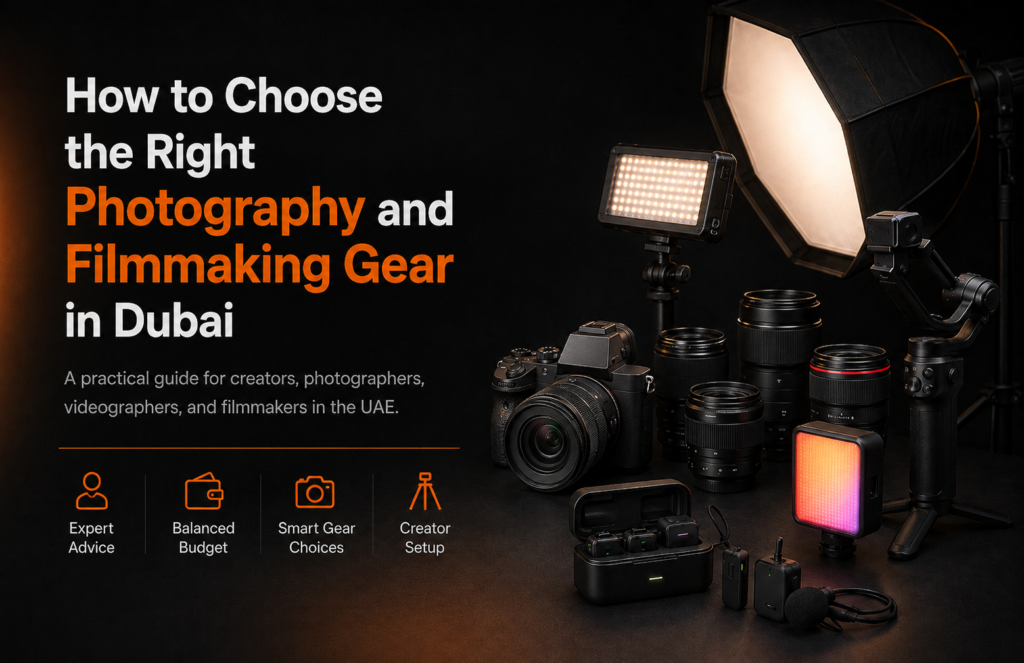
Choosing photography and filmmaking gear in Dubai can feel complicated because there are more cameras, lenses, microphones, lights, gimbals, monitors, storage options, and accessories than ever before. The challenge is not finding equipment; it is choosing equipment that matches your actual work, budget, shooting environment, and long-term plans.
For photographers, filmmakers, agencies, creators, production houses, and businesses, the right Photography Equipment Dubai setup should solve specific production problems. A wedding filmmaker needs speed and reliability. A real-estate photographer may prioritize wide-angle lenses and stable support. A YouTube studio needs clean audio and controllable lighting. A travel creator needs portability and battery efficiency.
Alfa Volt helps creators and production teams in the UAE evaluate gear as a complete system rather than as isolated products. This guide explains how to choose cameras, lenses, audio, lighting, stabilization, accessories, memory, and power so your investment supports the content you want to produce today and the projects you may take on tomorrow.
Quick Answer: How Should You Choose Photography and Filmmaking Gear?
Choose gear by starting with your main content type, working environment, required image and audio quality, portability needs, existing equipment, and total budget. Prioritize compatibility and balance across the entire setup instead of buying the most expensive camera first.
1. Start With Your Type of Work
The fastest way to narrow your options is to define what you shoot most often. Photography Equipment Dubai professionals use for portraits may be very different from equipment selected for events, products, property, documentaries, YouTube, or cinema. Before comparing models, write down the three most common jobs you expect the equipment to handle.
A portrait photographer may prioritize a high-quality camera, fast prime lenses, flattering lighting, and tethering accessories. A wedding photographer needs fast autofocus, low-light performance, backup camera bodies, spare batteries, and multiple memory cards. A filmmaker may require codecs, monitoring, audio inputs, ND filters, stabilization, and a rig that can support accessories.
This approach prevents overbuying. Instead of purchasing features you may never use, you invest in the capabilities that improve real projects.
2. Decide Between Photography, Video, or Hybrid Cameras
Many modern cameras are designed as hybrids that perform well for both still photography and video. Hybrid systems are useful for creators who shoot campaigns, events, social media, branded videos, and photography with the same kit. However, specialists may benefit from cameras designed primarily for one purpose.
For photography, consider sensor resolution, dynamic range, autofocus, burst speed, viewfinder quality, flash compatibility, and lens availability. For video, consider frame rates, recording formats, bit depth, overheating behavior, stabilization, microphone and headphone ports, and external recording support.
When comparing camera equipment UAE options, do not focus on one headline specification. A 4K or 8K label does not automatically make a camera suitable for professional work. Reliability, ergonomics, media cost, battery performance, and lens ecosystem can matter just as much.
3. Understand Sensor Size Before You Buy
Sensor size influences field of view, depth of field, low-light performance, camera size, and lens cost. Full-frame systems are popular for portraits, weddings, commercial work, and video because they can provide strong image quality and shallow depth of field. APS-C systems can deliver excellent results in a smaller and often more affordable package.
Micro Four Thirds and other compact systems can be attractive for travel, long-lens work, lightweight video rigs, and creators who value portability. The right choice depends on your complete system rather than a general ranking of sensor sizes.
Professional camera gear Dubai buyers should compare the weight and price of the lenses they will actually need, not only the camera body. A smaller sensor system may allow lighter lenses, while a full-frame system may provide advantages in low light or depth-of-field control.
4. Choose Lenses According to Your Subjects
Lenses should be selected around the scenes you repeatedly shoot. A versatile zoom can cover events, travel, interviews, and everyday work. A wide-angle lens is useful for interiors, architecture, property, and environmental shots. Fast prime lenses can be valuable for portraits, low-light work, and cinematic depth of field. Telephoto lenses help with sports, wildlife, stage events, and distant details.
The best photography equipment UAE setup is usually not the one with the greatest number of lenses. A smaller collection with clearly different purposes is easier to transport, faster to manage, and less expensive to maintain.
Before buying, check the lens mount, autofocus compatibility, stabilization behavior, filter size, minimum focus distance, weight, and whether the lens balances properly on your tripod or gimbal.
5. Build a Balanced Budget
A common mistake is to spend most of the budget on the camera body and then compromise on everything that supports it. A professional setup should allocate money for lenses, audio, lighting, memory cards, batteries, storage, support systems, bags, and required camera accessories Dubai creators may need.
The exact split will vary, but the principle is simple: budget for the complete workflow. A less expensive camera paired with better lenses, lighting, and audio may produce a stronger final result than a premium camera with weak supporting equipment.
Also plan for replacement and expansion. Batteries wear out, media capacity increases, and client requirements change. A small reserve in the budget can prevent your first setup from becoming too rigid.
6. Audio Matters as Much as Image Quality
For filmmaking, interviews, YouTube, podcasts, education, and corporate content, sound quality can immediately influence how professional the production feels. A viewer may accept a slightly imperfect image, but distracting noise, clipping, echo, or unclear dialogue is difficult to ignore.
Wireless microphones are useful when presenters or interview subjects need freedom of movement. Shotgun microphones can be mounted on cameras or booms. Studio microphones are suited to podcasts, livestreaming, and voiceovers. External audio recorders can add control and backup options for more demanding productions.
When selecting videography equipment Dubai teams should include wind protection, monitoring headphones, cables, adapters, and backup recording methods where needed.
7. Choose Lighting Based on Location and Control
Lighting needs depend heavily on where you shoot. A studio can support large lights, softboxes, C-stands, and permanent setups. A mobile creator may need compact battery-powered LED fixtures. Event teams may prioritize fast setup and portability, while filmmakers may require higher-output fixtures with modifiers and precise control.
For interviews and portraits, soft controlled light is often more flattering than a small hard light pointed directly at the subject. For product work, shape and reflection control may be more important than raw brightness. For creative video, RGB lighting can add color accents, while bi-color lighting can help match mixed environments.
Professional video equipment UAE buyers should think about power source, output, color quality, modifier compatibility, mounting, heat, and transport as part of the purchase decision.
8. Stabilization: Tripod, Monopod, Gimbal or Handheld?
Different support systems create different visual styles. Tripods are ideal for interviews, landscapes, architecture, livestreaming, and locked-off video. Monopods are useful for events and situations where the creator must move quickly. Handheld rigs can create a more immediate documentary feel, while gimbals are designed for smooth moving shots.
A gimbal is not automatically the best option. It adds setup time, requires balancing, consumes battery power, and has a payload limit. For some projects, a good tripod or lightweight monopod may be faster and more reliable.
Filmmaking gear UAE buyers should calculate the complete camera weight, including lens, cage, monitor, microphone, cables, and any other accessories, before choosing a stabilizer.
9. Do You Need a Camera Cage and External Monitor?
Camera cages can be useful when a creator needs to attach a monitor, microphone, handle, wireless transmitter, light, or other accessory. They also provide additional mounting points and can protect the camera body in a rigged setup. However, a cage is unnecessary if the camera is used mainly for lightweight photography.
An external monitor can make it easier to judge composition, focus, exposure, and color. Filmmakers may also use waveform, false color, focus peaking, and other monitoring tools. For solo creators, the ability to position a larger screen can improve self-recording and product demonstrations.
Camera equipment for filmmakers should be selected according to workflow. If a monitor or cage does not improve how you shoot, it may simply add weight and complexity.
10. Plan for Bright UAE Sunlight
Dubai and the UAE offer strong sunlight for much of the year. This is useful for photography, but video creators often need more control. Neutral density filters reduce the amount of light entering the lens, making it easier to maintain a chosen aperture and shutter speed without overexposing the image.
Outdoor photographers may also benefit from lens hoods, protective filters where appropriate, reflectors, flags, and portable shades. Heat should be considered when planning long recording sessions, particularly with cameras that generate significant internal heat.
Good filmmaking equipment Dubai planning should include the environment in which the equipment will actually operate, not only indoor test conditions.
11. Memory Cards, Storage and Data Safety
Memory cards should meet the performance requirements of the camera’s recording mode. High-resolution photography, high-frame-rate video, and high-bit-rate codecs may require faster cards. Buying the cheapest high-capacity card can create dropped frames, slow buffer clearing, or reliability issues.
Storage should be treated as part of production. After a shoot, important files should be copied to a working drive and backed up to another location or device. For paid work, relying on a single copy is a significant risk.
Photography gear UAE professionals choose should therefore include card readers, reliable drives, and a defined backup process in addition to cameras and lenses.
12. Check Compatibility Before Purchasing Accessories
Compatibility problems are one of the most common reasons gear becomes frustrating. Before buying, confirm lens mount, thread size, cage fit, cable type, connector standard, battery type, media format, gimbal payload, tripod plate, and monitor input/output.
Accessories from different brands can often work together, but the physical and electrical standards must match. Even small details such as cable direction, port location, or a plate blocking the battery door can affect usability.
A thoughtful camera accessories Dubai setup should therefore be planned as a system. This is especially important for professionals who want to move accessories between multiple cameras or crews.
13. Think About Portability and Travel
Dubai creators frequently move between offices, hotels, studios, event venues, restaurants, outdoor locations, and other emirates. Weight and packing efficiency can therefore have a direct impact on productivity.
A lightweight mirrorless camera, compact zoom, wireless microphone, portable LED light, mini tripod, and small bag can be ideal for social media and quick commercial work. Larger cinema rigs may be appropriate when image quality, monitoring, and crew-based production are the priority.
Professional camera gear Dubai users should compare not only performance but also how easily the equipment can be carried, assembled, powered, and packed after a shoot.
14. Buy for Your Current Needs but Allow Room to Grow
Equipment should solve current problems while leaving a sensible path for future expansion. Choosing a lens mount with strong support, a battery platform used across several devices, or a rigging standard that can be expanded can reduce future costs.
At the same time, avoid buying advanced equipment only because you may need it years later. Technology changes quickly, and unused gear ties up budget. A better approach is to create a capable core kit and upgrade when a real project requires more.
This keeps the setup practical and helps ensure every purchase contributes to real work.
15. Practical Gear Recommendations by Creator Type
Different creators benefit from different priorities. A product photographer should focus on lens sharpness, lighting control, stable support, and consistent backgrounds. A wedding creator should prioritize autofocus, low-light performance, fast lenses, battery life, backup bodies, and dependable audio. A real-estate creator needs wide lenses, tripods, gimbals, and lighting that can handle interiors.
YouTube and social media creators usually gain more from reliable autofocus, clean audio, compact lighting, and an efficient editing workflow than from extremely high-end cinema specifications. Corporate teams may value simple operation, repeatable setups, teleprompters, wireless microphones, and consistent branding.
By matching the kit to the creator type, Photography Equipment Dubai purchases become easier to prioritize.
16. Common Mistakes to Avoid
One mistake is buying only by specifications without considering workflow. Another is ignoring audio and lighting. Creators also frequently underestimate the cost of memory, batteries, bags, filters, cables, and storage. Some buy oversized gimbals or tripods that they later avoid carrying, while others select lightweight support that cannot safely hold the complete rig.
Another common problem is purchasing several overlapping lenses before mastering the ones already owned. Finally, creators sometimes change entire camera systems too quickly instead of identifying the specific limitation they are trying to solve.
A good buying decision begins with a clear production problem and ends with a solution that fits the rest of the system.
17. Why Choose Alfa Volt for Photography and Filmmaking Gear?
Alfa Volt helps creators, photographers, filmmakers, businesses, and production teams in the UAE explore equipment according to practical requirements. Rather than looking at a camera, light, microphone, or accessory in isolation, it is useful to evaluate how the component fits the complete production workflow.
Whether you are comparing Photography Equipment Dubai, filmmaking equipment Dubai, camera equipment UAE, professional camera gear Dubai, professional video equipment UAE, or camera accessories Dubai, compatibility and use case should remain central to the decision.
This system-based approach helps creators avoid unnecessary purchases and build kits that remain useful across multiple projects.
Simple Buying Checklist
- Define your three most common shooting scenarios.
- Set a total budget for the complete kit, not only the camera.
- Choose a camera system with lenses that match your work.
- Plan audio and lighting at the same time as the camera.
- Select support equipment according to total rig weight.
- Check mounts, ports, batteries, memory, and cable compatibility.
- Include spare power, backup media, storage, and protection.
- Buy only the accessories that solve real production problems.
- Leave room for future expansion without overbuying today.
Choose Gear That Supports the Way You Create
The right photography or filmmaking setup is not the one with the longest specification list. It is the one that lets you complete your work reliably, efficiently, and at the quality level your audience or clients expect. Cameras, lenses, audio, lighting, support, memory, power, and accessories should be evaluated as one connected system.
By starting with your real projects, building a balanced budget, checking compatibility, and leaving a sensible path for growth, you can make better equipment decisions and avoid unnecessary upgrades. Alfa Volt helps photographers, filmmakers, creators, and production teams explore Photography Equipment Dubai and filmmaking gear UAE according to practical production needs.