
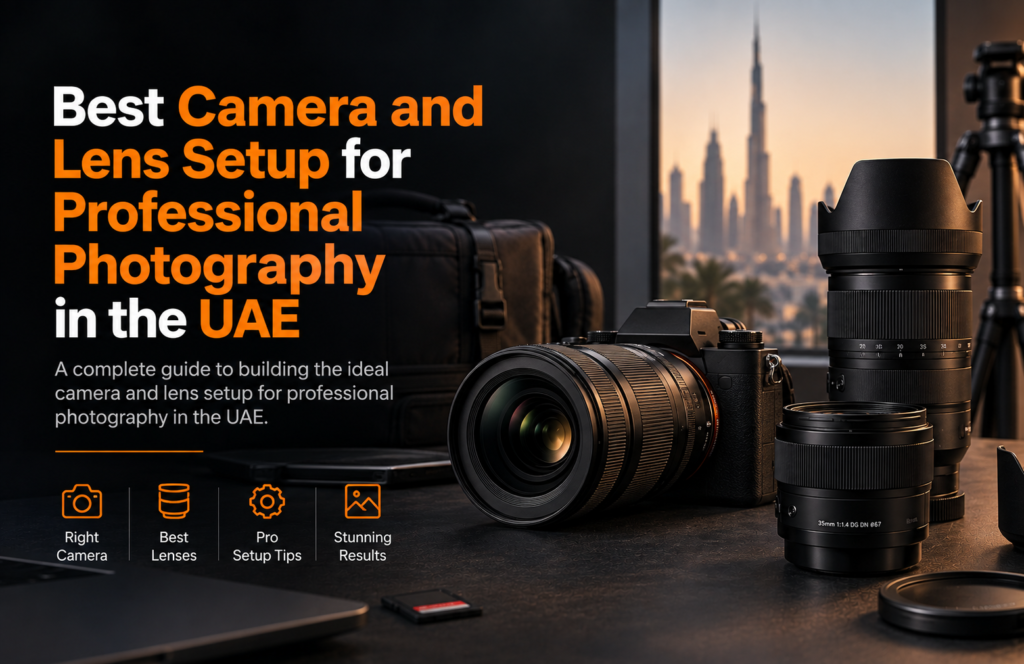
A practical professional photography setup starts with a camera that meets your output requirements and a lens suited to your subjects. Consider a 24–70mm f/2.8 zoom for varied assignments, an 85mm prime for portraits, or a true macro lens for small-product details.
Whether you are planning a fashion campaign in Dubai or a product catalog for a UAE business, build around the assignment rather than the most expensive specifications.
This Alfa Volt guide covers camera bodies, lens combinations, lighting, and support equipment for portrait, fashion, product, event, landscape, and commercial photography.
What Makes a Professional Camera and Lens Setup?
Camera Body
Compare sensor format, resolution, autofocus, and low-light performance against your assignments. Handle the camera before buying: controls and comfort deserve attention alongside specifications.
Lens Selection
Choose lenses around subject size, shooting distance, and framing. A versatile camera cannot compensate for a lens that lacks the required angle of view or close-focusing capability. Inspect sample images for edge detail, color fringing, and flare at the apertures you expect to use.
Lighting Equipment
Controlled lighting helps reveal texture, shape, and finish. Softboxes, diffusion, and reflectors let you adjust shadows and reflections rather than relying entirely on available light.
Tripod and Support Equipment
A stable tripod maintains framing during product sessions and longer exposures. Select a head that holds your camera-and-lens combination securely at the intended angle.
How to Choose the Right Camera for Professional Photography
Full-Frame vs APS-C Cameras
Full-frame cameras can offer advantages in low light, while APS-C systems can provide a smaller, lighter kit. Compare models of similar technology and generation. Neither format automatically makes photography professional; compare complete systems and actual camera performance.
Camera Resolution
Choose resolution around delivery requirements. Extra pixels offer cropping flexibility for commercial layouts, but more megapixels should not take priority over suitable lenses, lighting, or dependable focus. Before purchasing, ask whether the client needs website images, tightly cropped advertising layouts, or large prints. Those requirements provide a more useful starting point than a megapixel target alone.
Autofocus Performance
For portraits, consider reliable eye detection. For events and moving models, evaluate continuous autofocus and tracking. Test the camera with your intended lens, not just a showroom demonstration.
Low-Light Performance
Review image quality at the ISO settings your work requires. Higher ISO can enable faster shutter speeds in dim conditions, but noise and retained detail need careful evaluation.
How to Choose the Right Lens for Professional Photography
The focal-length guidance below assumes full-frame cameras. On APS-C, the same lens gives a narrower field of view. For example, 50mm on a 1.5× crop sensor frames similarly to 75mm on full frame.
24mm–35mm Lenses
Consider this range for landscapes, architecture, groups, and environmental portraits. Check the edges carefully when photographing people or products close to the camera.
50mm Lenses
A 50mm lens suits everyday commercial work, lifestyle scenes, and contextual portraits. Check its minimum focusing distance before selecting it for small tabletop products.
85mm Lenses
Consider 85mm for portraits, fashion, and tighter lifestyle compositions. Allow enough working space, particularly for full-length photographs or when using an APS-C camera.
90mm–105mm Macro Lenses
True macro models suit jewelry, watches, food textures, and small details. Check maximum magnification: a focal length near 100mm does not automatically mean macro capability.
70mm–200mm Lenses
Telephoto zooms help frame distant subjects at events, sports, and outdoor sessions. They also support tighter portraits without requiring you to stand close to the subject.
Best Camera and Lens Combinations for Different Photography Styles
Portrait Photography Setup
Consider a mirrorless camera with dependable eye autofocus and an 85mm lens. Add a reflector or controlled light, and assess whether your room accommodates the required framing.
Fashion Photography Setup
Pair a suitable camera with a 24–70mm zoom for changing compositions. Consider an 85mm prime for tighter campaign images, while checking garment proportions and fabric detail.
Product Photography Setup
Combine a camera offering manual controls with a standard lens for overall views. Add a true macro lens for small details, plus stable support and controlled lighting.
Wedding and Event Photography Setup
Consider a camera with reliable tracking and suitable high-ISO performance, paired with a 24–70mm f/2.8. Add a 70–200mm when you need to photograph from farther away.
Landscape Photography Setup
Match your camera with a wide-angle lens for expansive scenes and a standard lens for selective compositions. Base your tripod choice on the kit and shooting conditions.
Commercial Photography Setup
Choose equipment after confirming the shot list and output sizes. A campaign combining products, people, and interiors may justify different lenses rather than one universal setup.
Recommended SIGMA Lenses for Professional Photography
The four models below have Sony E-mount and L-Mount versions. Select the correct version for your camera; their availability does not imply compatibility with every mirrorless system.
SIGMA 24-70mm F2.8 DG DN II
The Art model combines a versatile zoom range with a constant f/2.8 maximum aperture and HLA autofocus. Consider it for events, portraits, and commercial assignments requiring frequent reframing.
SIGMA 50mm Lenses
The SIGMA 50mm F1.4 DG DN Art is an option for lifestyle and general commercial photography. Its 45cm minimum focusing distance and 1:6.8 magnification mean it is not a life-size macro lens.
SIGMA 85mm F1.4 DG DN
The Art model offers an f/1.4 maximum aperture for shallow-depth-of-field portrait work. Consider it for fashion and lifestyle photography, while allowing sufficient distance for your composition.
SIGMA 105mm F2.8 DG DN Macro
The Art model provides 1:1 magnification and a 29.5cm minimum focusing distance. Consider it for jewelry and product details; focusing distance is not the clearance between the lens front and subject.
Best Camera and Lens Setup for Product Photography
Small Product Photography
Build a repeatable tabletop setup with a tripod, controlled light, and suitable magnification. Photograph complete items and details separately instead of expecting one composition to serve every purpose. For a perfume bottle, plan a clean overall view, a label close-up, and a styled campaign image before deciding which lens each shot needs.
Fashion and Clothing Photography
Test 50mm–85mm options against your studio dimensions. Keep camera height, lighting, and garment positioning consistent, and inspect the complete outfit before approving catalog framing.
Jewelry Photography
Combine a true macro lens with diffusion and stable support. Where one exposure cannot keep enough detail sharp, consider focus stacking: merging photographs focused at different distances.
Best Camera and Lens Setup for Portrait Photography
Studio Portraits
Compare 50mm and 85mm framing in your actual studio. Select the aperture according to the required depth of field, rather than automatically using the lens’s widest setting.
Outdoor Portraits
Consider an 85mm prime or telephoto zoom. Increase subject-to-background distance for stronger separation, and leave enough space to communicate comfortably while maintaining your chosen composition.
Prime vs Zoom Lenses for Professional Photography
Advantages of Prime Lenses
Prime lenses have fixed focal lengths, and many offer wide maximum apertures. They can provide strong optical performance and creative control, but compare individual models rather than assuming universal superiority.
Advantages of Zoom Lenses
Zoom lenses provide several focal lengths without a lens change. This flexibility supports faster reframing when subjects move or when event access limits your camera position.
Which Is Better for Professional Photography?
Choose a zoom when coverage and speed matter most. Choose a prime for a particular look or specialist requirement. A practical kit can combine both without duplicating every focal length.
Building a Professional Photography Kit in the UAE
When discussing equipment with Alfa Volt, describe your regular assignments and existing camera system. Separate essential purchases from occasional requirements so the proposed kit addresses real gaps in your workflow.
Camera Body
Select a camera that meets your delivery, focusing, and handling requirements. Keep room in the budget for the rest of the setup.
Primary Lens
Start with the lens that covers your most frequent assignment. Consider a standard zoom for mixed work or a suitable prime for consistent studio sessions.
Secondary Lens
Add a second lens only when it solves a clear limitation, such as insufficient reach, close-up magnification, or the required portrait framing.
Lighting
Start with a controllable light, modifier, and reflector. Learn to reproduce a useful lighting arrangement before expanding to more complicated setups.
Tripod
Check stability with the actual camera and lens attached. Prioritize secure positioning and convenient height adjustment for your working environment.
Memory Cards and Batteries
Carry charged spare batteries and compatible memory cards. Establish a backup routine, and confirm that your storage workflow can handle the planned assignment.
Camera and Lens Setup for Professional Photographers in Dubai
Studio Photography
For a Dubai studio brief, prioritize repeatable results: mark camera positions, record lighting arrangements, and agree on framing before photographing a complete collection.
Outdoor Photography
Plan equipment protection for heat and sand. Minimize exposed lens changes in dusty conditions and allow cold equipment to acclimatize when moving into warmer surroundings.
Commercial Photography
For UAE brand campaigns, agree on horizontal, square, and vertical deliverables before shooting. Leave purposeful cropping space rather than forcing every layout from one tightly framed image. For example, plan separate compositions for a website banner and a vertical social advertisement, with space reserved for headlines or branding.
Common Mistakes When Choosing a Camera and Lens
Choosing the Camera Before the Lens
Plan the camera and lens together. Avoid spending the whole budget on a body before checking which lenses your assignments require.
Buying Based Only on Megapixels
Treat resolution as one selection factor. Assess focus, lighting requirements, handling, and output needs before paying for additional pixels.
Choosing the Wrong Focal Length
Test framing in the actual space. Perspective depends on camera position; moving too close can exaggerate near-to-far proportions.
Ignoring Camera Compatibility
Confirm the exact camera mount and lens version before ordering. Check manufacturer compatibility information rather than assuming all products from a brand fit.
Buying More Equipment Than Needed
Build around regular assignments. Consider renting specialist equipment for occasional projects instead of purchasing lenses without a defined use.
Frequently Asked Questions
There is no universal combination. Consider a capable mirrorless camera and standard zoom for varied work, adding a portrait prime or macro lens when the assignment requires it.
Yes. It is useful for lifestyle, general commercial work, and contextual portraits. Account for sensor size, studio space, and the specific lens’s close-focusing limits.
Neither is always better. At matched framing, 85mm requires more distance; 50mm can be more practical when including surroundings or working in limited space.
Consider the 24-70mm F2.8 DG DN II for versatility, the 85mm F1.4 DG DN for portraits, or the 105mm F2.8 DG DN Macro for fine details.
Start with manual camera controls, a suitable standard or macro lens, stable support, and controlled lighting. Match resolution and magnification to the products and required output.
Final Thoughts
The best camera and lens setup for professional photography in the UAE matches the brief, working space, and delivery requirements. Prioritize compatible equipment and repeatable results rather than collecting specifications. Upgrade the weakest part of your workflow first, whether that means a more suitable lens, better light control, or a more dependable support system.
A clear equipment plan should make assignments easier, not simply enlarge your kit.
Explore Professional Cameras and Lenses with Alfa Volt
Planning your next setup? Contact Alfa Volt with your camera model, photography style, budget, and typical assignments. Explore suitable equipment and confirm the exact mount, current availability, and warranty terms before ordering.