
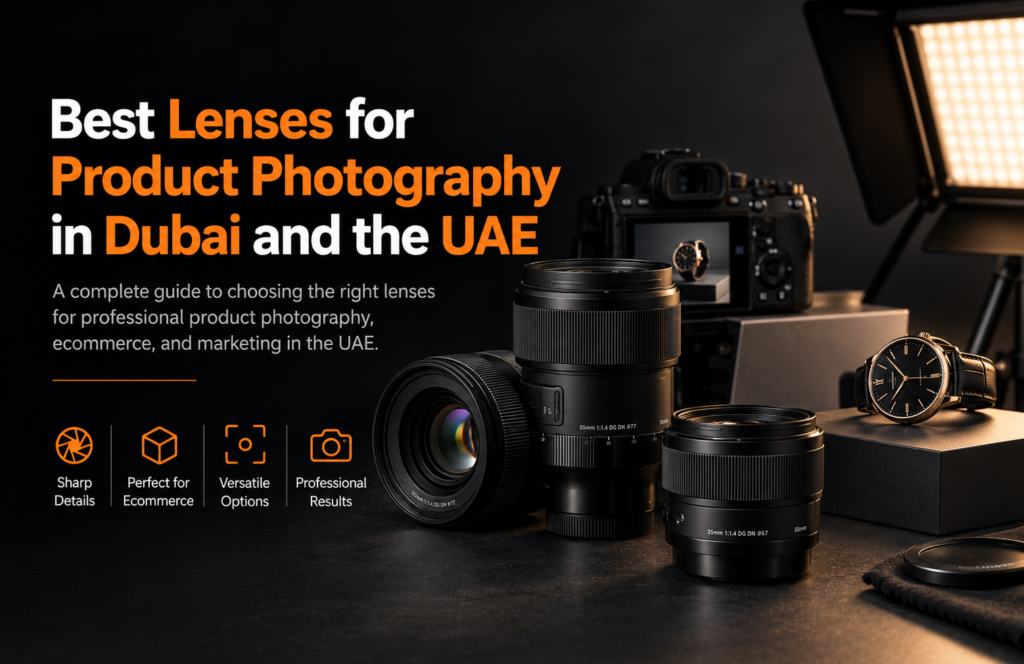
Choosing a product photography lens starts with what you sell: a full outfit, a perfume bottle or a tiny gemstone. Each demands a different balance of framing, detail and shooting distance.
For general products, consider a 50mm lens. For jewelry and watch details, consider a true macro lens around 90mm–105mm. Sensor size, available space and required magnification should guide the final choice.
Whether the brief involves an online perfume store, a fashion catalog or a restaurant campaign, define the images required before choosing equipment. A clear shot list helps separate overall product photographs from lifestyle scenes and close-up detail images. This helps make equipment comparisons practical.
This Alfa Volt guide explains how to compare lenses for e-commerce, commercial campaigns and studio photography across Dubai and the UAE.
What Makes a Lens Good for Product Photography?
Sharpness and Detail
Look for clear labels, defined textures and consistent detail across the product. Evaluate sample images at your intended shooting aperture, rather than judging sharpness from specifications alone.
Focal Length
Focal length controls framing and angle of view. Perspective depends on camera position: moving closer with a wide lens changes how near and distant product features appear.
Aperture
Wider apertures create shallower depth of field. For catalog images, test around f/8–f/11, then adjust for product depth; these are starting points, not universal settings.
Stopping down further is not always better: diffraction can soften fine detail. For close-up products with depth, focus stacking may be more effective than using the smallest available aperture.
Minimum Focusing Distance
Minimum focusing distance is measured from the camera’s sensor, not the lens front. Also check maximum magnification to understand close-up capability.
Distortion Control
Inspect packaging edges, circular objects and proportions in test shots. Choose a lens and camera position that present products accurately rather than exaggerating their shape.
Best Focal Lengths for Product Photography
These examples assume full-frame cameras. An APS-C camera produces a narrower field of view with the same lens, so account for your sensor format. On a 1.5× crop-sensor camera, a 50mm lens gives a field of view similar to 75mm on full frame.
35mm Lenses
Consider 35mm for styled interiors, larger products and lifestyle compositions. Leave room around the subject rather than filling the frame from extremely close range.
50mm Lenses
A 50mm lens is a practical starting point for general products, tabletop arrangements and environmental images. Check close-focusing performance before choosing it for small accessories.
70mm–85mm Lenses
Consider this range for cosmetics, clothing details and tighter commercial compositions. Allow enough camera-to-subject distance, especially when photographing larger products.
90mm–105mm Macro Lenses
Choose a genuine macro model for jewelry, watch faces and fine textures. Focal length alone does not establish macro capability; check the magnification specification.
Best Lenses for Product Photography in Dubai and UAE
The following recommendations match published specifications to shooting needs. Confirm the exact model, camera mount and availability before buying.
SIGMA 50mm Lenses
The SIGMA 50mm F1.4 DG DN Art is worth considering for general products and styled commercial scenes. It supports Sony E-mount and L-Mount, focuses to 45cm and reaches 1:6.8 magnification. Its wide aperture offers creative background separation, but it is not a life-size macro lens.
SIGMA 70mm Macro Lens
The SIGMA 70mm F2.8 DG MACRO Art offers 1:1 magnification and a 25.8cm minimum focusing distance, making it a candidate for accessories and small products. SIGMA lists this model as discontinued, so check remaining stock, condition and the specific mount rather than assuming new availability.
SIGMA 90mm Lens
The SIGMA 90mm F2.8 DG Contemporary offers a compact option for tighter product and fashion compositions. Its minimum focusing distance is 50cm, with maximum magnification of 1:5. It is therefore useful for selective close-ups, but should not be confused with a 1:1 macro lens.
SIGMA 105mm F2.8 DG DN Macro
The SIGMA 105mm F2.8 DG DN MACRO Art offers 1:1 magnification, a 29.5cm minimum focusing distance, and Sony E-mount or L-Mount versions. Among these options, it is the strongest specification-based starting point for dedicated jewelry, watch and fine-detail photography on compatible cameras.
Best Lens for Different Types of Product Photography
Best Lens for Jewelry Photography
Prioritize true macro magnification for rings and gemstone settings. For deeper subjects, consider focus stacking: combining photographs focused at different distances into one detailed image.
Best Lens for Watch Photography
Consider a 90mm–105mm macro for dial details. Leave space for lighting and adjust camera angles carefully; reflective surfaces can reveal the camera itself.
Best Lens for Clothing Photography
Test 50mm for complete outfits and 70mm–85mm for tighter compositions. For abayas, dresses or jackets, prioritize consistent garment proportions and sufficient studio space.
Best Lens for Cosmetics Photography
Use a standard or short telephoto lens for bottles and packaging. Add macro photography when the brief requires lipstick texture, applicator details or close-up branding.
Best Lens for Electronics Photography
Plan separate overall and detail images. Test a standard lens for complete devices, then a macro lens for small ports, controls and component finishes.
Best Lens for Food Product Photography
Consider 35mm–50mm for contextual arrangements and packaging. Reserve macro shots for specific textures, while keeping the food’s appearance and presentation central to the composition.
Best Lens for E-Commerce Product Photography
Product Photography for Online Stores
Choose a lens that frames your typical products comfortably. Establish repeatable camera positions, background treatment and crop proportions before photographing an entire catalog.
Product Photography for Shopify Stores
Plan a clean primary image, useful detail photographs and a contextual view. Keep labels legible and inspect the final images at the size customers will actually see.
Product Photography for Social Media
Create separate compositions for square and vertical placements. Leave deliberate space for campaign text, but keep essential product details away from crop boundaries.
Prime vs Zoom Lenses for Product Photography
Advantages of Prime Lenses
Prime lenses have a fixed focal length, and many offer wide maximum apertures. Compare individual models rather than assuming every prime automatically outperforms every zoom.
Advantages of Zoom Lenses
Zoom lenses simplify reframing when product sizes vary. A standard zoom, such as a 24–70mm, can cover multiple commercial compositions without repeated lens changes.
Which One Should You Choose?
Choose a prime for a repeatable setup, a zoom for varied assignments, or a dedicated macro when your work depends on small-product detail.
How to Choose the Right Product Photography Lens
When approaching Alfa Volt, bring a sample product and your camera details. Explain whether the priority is complete-item catalog coverage, creative advertising images or extreme close-ups; each points toward a different setup.
Consider Product Size
List your smallest and largest products. Test both before committing to one lens for the entire catalog.
Consider Working Distance
Allow space between the lens front and product for lighting, reflectors and adjustments. This working distance differs from minimum focusing distance.
Choose the Right Focal Length
Match your preferred framing to the actual room. Avoid selecting a long lens that leaves insufficient space for larger products.
Check Minimum Focusing Distance
Compare maximum magnification alongside focusing distance. A lens that focuses relatively close may still be unsuitable for life-size detail photography.
Consider Aperture
Budget for adequate lighting rather than paying for maximum aperture alone. Select your shooting aperture according to the depth that needs to remain sharp.
Check Camera Compatibility
Check the complete camera model and lens mount. The SIGMA 105mm DG DN Macro versions discussed here are Sony E-mount and L-Mount, not universal fittings.
Product Photography Equipment You Need Besides a Lens
Camera
Prioritize dependable manual controls and enough resolution for your final output. Extra resolution can help with cropping, but assess your actual delivery requirements before upgrading.
Tripod
A stable tripod helps preserve framing and reduces camera movement. It is particularly useful when photographing stationary products with longer exposures.
Studio Lighting
Build a repeatable lighting arrangement. Diffused window light can work, while a controlled setup gives you more freedom to position illumination around the product.
Softboxes and Reflectors
Use diffusion to soften light and reflector cards to manage shadows. White cards brighten shadow areas; black cards can deepen edges and improve separation.
Backgrounds
Choose clean backgrounds that support the product rather than compete with it. Keep a consistent treatment for catalog photography and introduce styled surfaces deliberately.
Tips for Better Product Photography in Dubai
Use Controlled Lighting
Check glossy surfaces for distracting reflections. Reposition lights and diffusion before changing lenses; lighting is essential to showing product texture and finish clearly.
Use a Tripod
Lock the camera once the composition is approved. Trigger it remotely or use a timer to avoid disturbing the setup during exposure.
Maintain Consistent Camera Position
Mark the tripod and product positions. Keep camera height and angle consistent for comparable catalog views, and document any intentional changes.
Capture Multiple Angles
Build a simple shot plan: overall view, reverse view, important details and an image showing scale or use. Adapt it to each product.
Keep Product Colors Accurate
Match white balance to the lighting and photograph a neutral reference card. Review edits against the physical product instead of increasing saturation for impact.
Common Mistakes When Choosing a Product Photography Lens
Choosing Only Based on Aperture
Do not make f/1.4 your main buying criterion. For a catalog brief, prioritize the required detail, magnification and usable shooting distance.
Using an Overly Wide Lens
Filling the frame from very close range can exaggerate near-to-far proportions. Step back and reassess framing when products look unnaturally stretched.
Ignoring Minimum Focusing Distance
Check whether your smallest product can fill enough of the frame while remaining in focus, rather than relying on cropping afterward.
Choosing the Wrong Focal Length
A jewelry specialist and a furniture photographer need different setups. Buy for your most frequent assignment, not an unrelated recommendation.
Ignoring Camera Compatibility
Confirm the mount before payment. Similar product names do not establish compatibility; check the exact version against your camera system.
Frequently Asked Questions
Start with 50mm for general products or a true macro for small details. The best choice depends on subject size and shooting space.
Yes, particularly for general products and lifestyle compositions. However, check the specific lens’s magnification before expecting it to capture tiny details.
It is preferable when high magnification matters, such as jewelry details. It is not automatically the best choice for every product or composition.
Consider a true macro around 90mm–105mm. Compare actual working distance and magnification rather than choosing by focal length alone.
Among the models discussed, consider the 105mm F2.8 DG DN MACRO Art for fine details and the 50mm F1.4 DG DN Art for general compositions.
Final Thoughts
The best lenses for product photography in Dubai and the UAE suit the products, camera and working environment. Prioritize useful magnification, accurate presentation and repeatable results over headline specifications.
Explore Professional Photography Equipment with Alfa Volt
Planning a product photography setup? Contact Alfa Volt with your camera model, product dimensions, budget and shooting-space details. Explore relevant photography equipment and confirm the exact lens mount, current availability and support terms before placing an order.